
By Josh Proto

Dec 17, 2025
By Josh Proto
Dec 17, 2025
Inside the Olio Apps Hackathon: How AI-Assisted Game Development Played Out in Practice
A few times each year, Olio Apps pauses its regular work building production software for startups and enterprises and does something deliberately different. The team steps away from client delivery and focuses on building something entirely new.
In November 2025, that pause took the form of an internal hackathon. The theme was simple: games!
What followed was not just a showcase of creativity, but a revealing snapshot of how modern teams are actually using AI tools, real-time infrastructure platforms, and lightweight planning to ship working software under extreme time constraints. Over the course of a single day, multiple teams designed, built, and deployed playable games, many of them with multiplayer capabilities, several of them demoed with live participants.
This post recaps the hackathon demos and judging, highlights the engineering patterns that emerged, and explains why one project ultimately stood out as the winner.
A Hackathon Focused on Shipping Fun Games
Unlike hackathons that reward pitch decks or conceptual ambition, this event prioritized playability and completeness. Teams were expected to produce something people could actually interact with. The result was a set of projects that felt closer to production experiments than disposable prototypes. Across the demos, several common themes emerged. Teams were also required to utilize AI code assistants, though they mainly used them to accelerate and test development patterns rather than leaving AI to vibe code their entire game. They favored managed infrastructure over bespoke backends and they optimized for fast deploy/test loops rather than architectural perfection. And in many cases, they discovered the same lesson that although AI can accelerate development dramatically, it does not remove the need for tech stack planning, scope control, or debugging.Goat Wizard: Real-Time Multiplayer Battle Royale
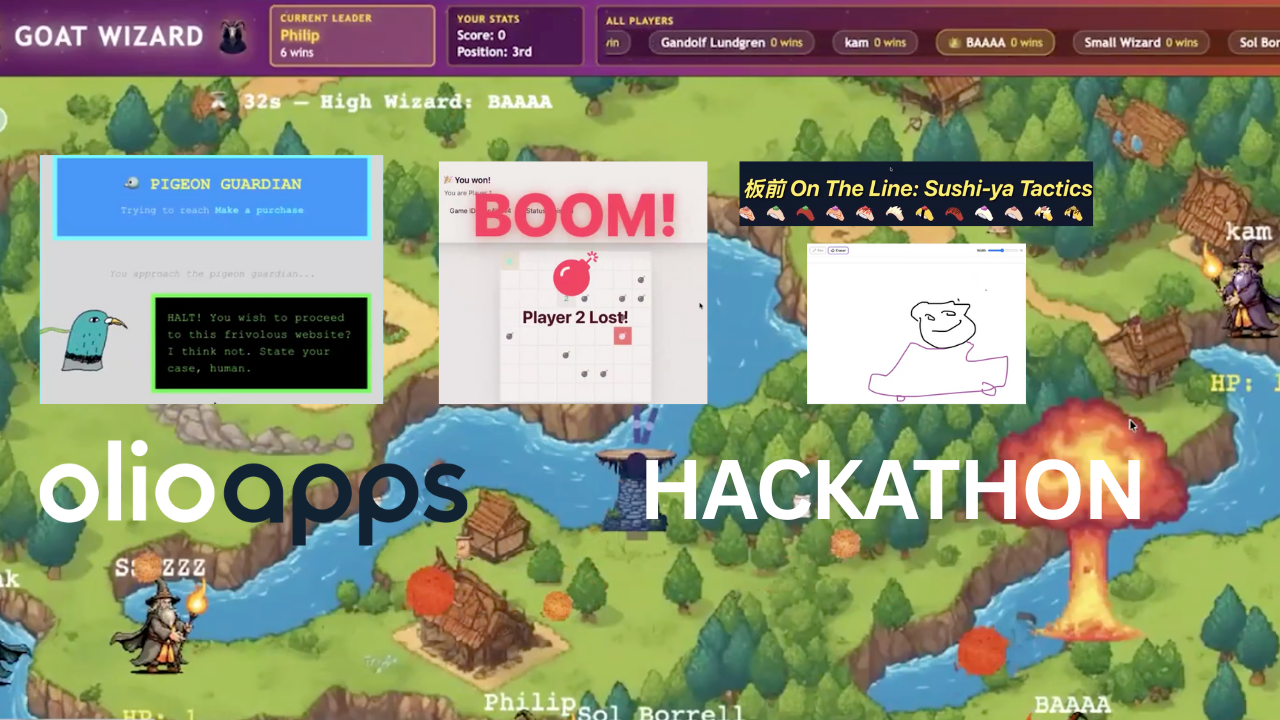
One of the first demos came from the team behind Goat Wizard, a fast-paced multiplayer game inspired by King of the Hill mechanics. Players compete to remain the "High Wizard," earning points by staying atop a central tower while others attempt to knock them off using fireballs. Power-ups appear dynamically, granting movement speed or additional projectiles, and the game quickly becomes chaotic as more players join. What stood out during the demo was not just the gameplay, but the infrastructure holding up under load. The team deployed the game server using TypeScript on Railway, with a Phaser.js client hosted on Netlify. Assets were generated using Layer AI, which allowed the team to move quickly without hand-drawing every element. The most telling moment came when the judges invited the entire company to join the game simultaneously. What had only been tested with three players suddenly ballooned to dozens. The result was total mayhem. Fun, chaotic, wizard fueled mayhem. But the game stayed stable enough! That stress test revealed both the strengths and limits of AI-assisted development. Core mechanics and physics were relatively easy to implement with AI support. UI layering, scoreboards, and CSS integration proved far more time-consuming. As one developer noted, "the mechanics were easy; the simple things weren't."Breakin' the Louvre: A Multiplayer Heist with Narrative Ambition
Another team presented Breakin' Into the Louvre, a cooperative multiplayer heist game inspired by classic crime films. Players infiltrate a museum, evade guards, discover a control room, and attempt to steal crown jewels before escaping. The game featured room-based exploration, guard encounters, friendly fire mishaps, and a win condition tied to coordinated objectives. Built using a similar Railway-hosted client/server setup, the game leaned heavily on Claude for code generation and AI-assisted problem solving. Assets were created quickly, sometimes literally on a bus ride before the demo. The team divided responsibilities along natural lines: one developer focused on map and sprite design, another on backend logic, and another on deployment and DevOps. Despite running out of time to polish every mechanic, the demo highlighted how far a small team can get in one day when infrastructure and tooling friction are minimized. The game was not bug-free. Players died unexpectedly. Friendly fire caused confusion. But the overall loop was clear, playable, and ambitious!The Ladies IT Department: A Game That Weaponized Friction with Pigeons!
One of the most creative entries came from The Ladies IT Department, who took a different approach to the "games" theme. Rather than building a standalone game, the team created a browser extension designed to interrupt online shopping. When users visited predefined trigger sites, a modal launched a series of increasingly absurd challenges: trivia questions, item-collection mini-games, persuasion attempts involving pigeons, combat encounters, and mandatory waiting periods. The goal was not to "win" in the traditional sense, but to create enough friction that users forgot why they wanted to make the purchase in the first place. Did I mention the browser extension was pigeon themed? It relied on TypeScript, React, and Chrome extension APIs. Artist-drawn pigeon assets were integrated with AI assistance, with Claude handling placement and logic integration. The demo was intentionally chaotic, occasionally unwinnable, and comically self-aware. While it did not take first place, it received special recognition from the judges for originality and social commentary.Multiplayer Minesweeper: A Classic with a Novel Twist
The eventual winner of the hackathon was a deceptively simple idea: multiplayer Minesweeper. Hank and Jonathan took the classic single-player puzzle game and reimagined it as a competitive, turn-based multiplayer experience. Players alternate between placing mines and revealing tiles on a shared board. Every action alters the information landscape for everyone else. The game featured lobbies, difficulty selection, theming, leaderboards, chat, and spectator mode. Players could even engage in "informational warfare," stealing flags or distracting opponents through forced chat pop-ups. The frontend was built with React and TypeScript, bundled with Vite, and deployed to GitHub Pages. The backend relied on Supabase for state management, using Postgres subscriptions to propagate real-time updates to all connected clients. Rather than over-engineering the game, the team treated the game state as a single evolving record. When the state changed, clients re-rendered accordingly. This approach simplified synchronization and reduced failure modes. The judges highlighted three reasons the project stood out. First, completeness. The game felt finished. Players understood how to play. Features worked together cohesively. Second, social interaction. Spectators could join, watch, and chat. The game encouraged banter and participation rather than passive viewing. Third, a novel twist on a classic. Multiplayer Minesweeper was immediately legible yet surprising, an idea that felt obvious in hindsight but rare in execution. The combination proved too good to ignore.Pictionary Party and Sushi Tactics: Experiments at the Edge
Other teams pushed different boundaries. Pictionary Party explored AI-initiated gameplay, where generated images and prompts flowed between players in a chain. The team built lobbies, drawing canvases, theming, and Firebase-backed state management. While the game did not fully reach its final rounds due to state synchronization issues, the demo showcased thoughtful UI design and ambitious scope. Sushi Tactics took inspiration from real kitchen workflows, creating a cooperative game that required verbal communication and precise execution. One player acted as the chef, assembling dishes based on spoken orders from an expo. The backend used Express and Socket.IO, while the frontend relied on React and a custom "paper doll" engine for assembling ingredients. Both projects reinforced a key insight from the hackathon: AI tools can accelerate implementation, but complex state transitions and coordination remain difficult under time pressure.How the Judging Played Out
Judging prioritized several factors. Completeness mattered. Games that reached a playable, coherent state scored higher than those with ambitious but unfinished mechanics. Taste mattered. Judges considered whether the game felt good to play, not just whether it was technically impressive. Social dynamics mattered. Projects that encouraged interaction, chaos, and participation resonated more strongly during live demos. By those criteria, multiplayer Minesweeper emerged as the clear winner, with The Ladies IT Department receiving a special mention for creativity and its ability to re-engineer an experience as straightforward as a simple ecommerce flow.What the Hackathon Revealed About AI-Assisted Development
Across all demos, a consistent pattern emerged. AI tools like Claude and Cursor were widely used. They excelled at generating boilerplate, physics logic, and scaffolding. They struggled with UI composition, CSS, and edge-case reasoning. Teams that succeeded were not those that relied most heavily on AI, but those that paired AI acceleration with clear constraints, fast feedback loops, and expert human judgment. The hackathon made one thing clear. Gen AI may change the pace of development, but it does not replace the need for planning, taste, or key decision-making.Josh Proto
Cloud Strategist
Josh is a Cloud Strategist passionate about helping engineers and business leaders navigate how emerging technologies like AI can be skillfully used in their organizations. In his free time you'll find him rescuing pigeons with his non-profit or singing Hindustani & Nepali Classical Music.
Share This Post
Newsletter
Monthly updates, posts and podcasts.