
By Philip Brocoum

May 20, 2026
By Philip Brocoum
May 20, 2026
We Sent Our Candidate a Take-Home Open-Book Test - Yes, Even in the Age of AI
AI is creating a new challenge for hiring teams. The traditional signals used to evaluate engineering talent: speed, recall, and isolated problem-solving, are becoming less reliable in environments where external assistance is increasingly difficult to detect and even harder to control consistently.
Most engineering leaders have felt this in some form over the past year: candidates who perform well in interviews don't always perform well in real roles, and strong engineers sometimes fail in interview settings that don't resemble actual work.
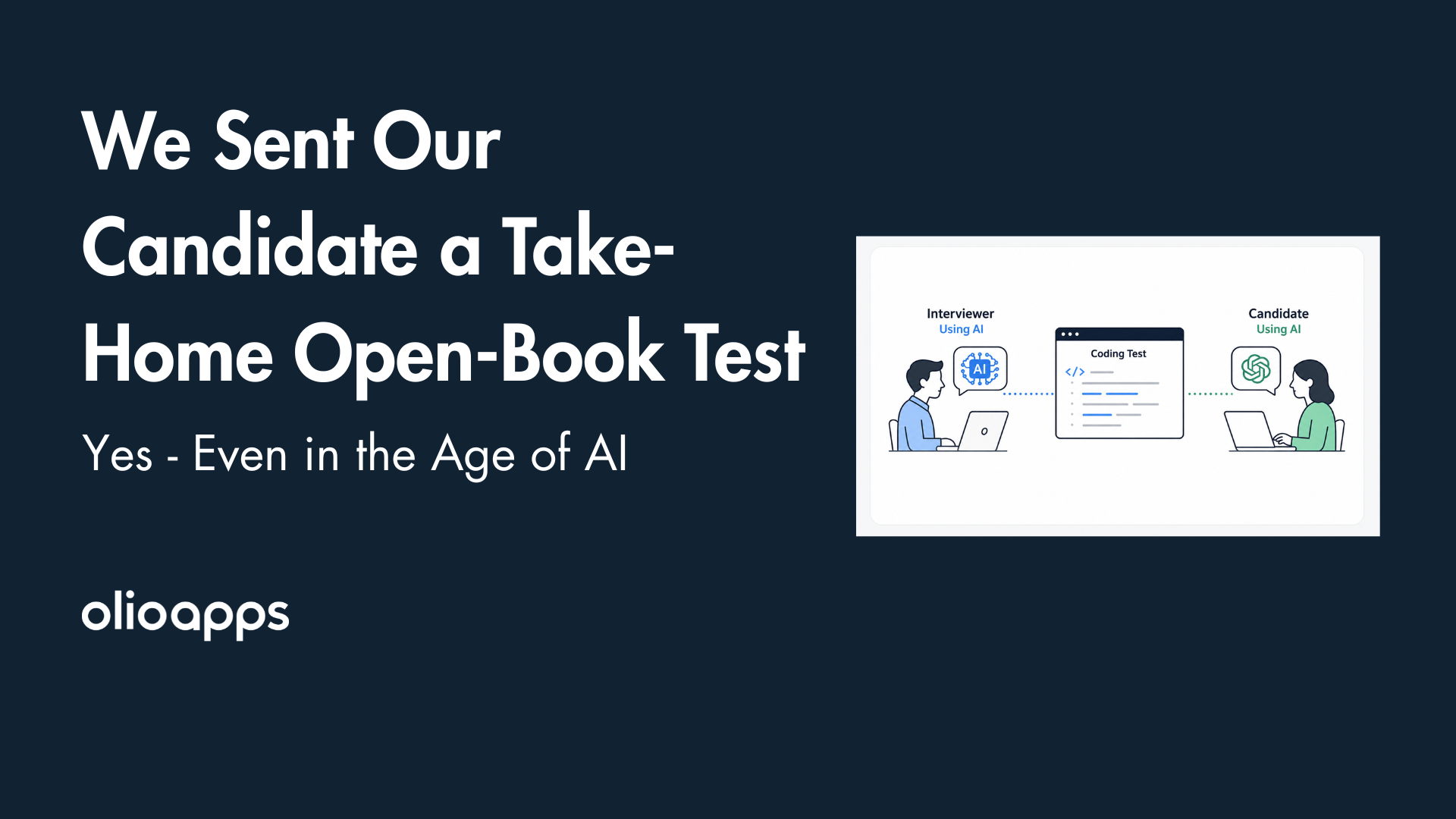
At the same time, the interview process itself is changing. AI tools are now widely available that can assist candidates during coding interviews, behavioral screens, and take-home exercises in real time. Some are general-purpose tools used quietly in the background. Others are systems designed specifically for live interview assistance.
In this post, we'll explore how AI interview tools are reshaping technical hiring, why this is weakening the signal of traditional interview formats, and how companies are beginning to rethink what "good evaluation" looks like in practice.
AI Tools Are Changing the Interview Environment
In recent years, a new category of software has emerged specifically designed to assist candidates during technical interviews. These tools go beyond general-purpose AI assistants and are built to operate in real time during coding tests, behavioral interviews and live problem-solving sessions. Some act like invisible interfaces that interpret interview prompts as they are being delivered. Others integrate directly with coding environments such as CodeSignal, HackerRank, CoderPad, or LeetCode, suggesting solutions or generating code while the candidate is actively in an interview session. While these tools are often discussed in terms of cheating, their broader impact is more structural: they reduce the reliability of traditional interview formats as a measure of individual capability. When assistance is readily available in the background, it becomes harder to distinguish between a candidate's own reasoning, preparation, and real-time external support.Why Technical Hiring Is Getting Harder to Trust
For many years, technical interviews relied on constrained problem-solving. Candidates solved algorithmic or puzzle-style questions under time pressure, often without external tools. While imperfect, this created a consistent way to compare candidates. AI tools change that dynamic. Candidates can now generate high-quality solutions to standard problems in seconds. But this doesn't necessarily reflect engineering judgment, system design ability, or real-world trade-offs - it reflects access to better tools. As a result, coding interviews are becoming less reliable at distinguishing memorization and assisted problem-solving from true engineering skill. This is forcing organizations to rethink what they are actually measuring. A key issue is that these interview formats often blur the difference between memorization, assisted problem-solving, and true engineering judgment. A candidate may appear to perform well by recalling patterns or using external assistance, but that does not necessarily indicate an ability to reason through unfamiliar problems or make real-world trade-offs. As AI tools become more capable, this distinction becomes even harder to observe in controlled interview environments.Why Take-Home and Realistic Work Is Gaining Traction
One of the consistent shifts in hiring is toward more realistic, lower-pressure assessments. Take-home exercises and practical assignments allow candidates to work in conditions closer to real engineering work, using documentation, tools, and structured reasoning rather than relying on rapid recall under artificial constraints. More importantly, these formats shift evaluation away from the final answer and toward the thinking process itself. Hiring teams gain insight into how candidates approach ambiguity, make trade-offs, and communicate reasoning when the pressure of live performance is removed. This tends to surface stronger signals of day-to-day engineering performance. As this shift continues, organizations are adjusting their interview processes in different ways. Some are moving toward practical engineering scenarios, system reviews, or discussions of past work. Others use structured take-home exercises that better reflect real working environments. Some companies now incorporate AI tools directly into the evaluation process, focusing less on whether they are used and more on how effectively candidates can use them while still demonstrating core engineering judgment. At the same time, others maintain strict bans on AI in interviews, especially in highly standardized screening environments. The result is a fragmented landscape where expectations vary widely across organizations.The Core Issue: Interview Performance vs Real Work
At the center of this shift is a growing recognition that interview performance and job performance are not the same thing. Interviews are typically short, high-pressure, and isolated. Real engineering work is iterative, collaborative, and heavily tool-supported. Engineers spend much of their time researching, reviewing systems, making incremental changes, and working through ambiguity over longer time horizons. When interviews don't reflect how the job actually works, candidates tend to adapt to the interview format itself rather than what the job actually requires. AI tools made this mismatch more visible, but it did not create it.Rethinking How Candidates Are Evaluated
As AI becomes more integrated into both workflows and interview environments, organizations are being forced to reconsider what they actually value in candidates. In many cases, the signals are shifting away from pure problem-solving speed or memorization and toward:- how candidates reason through unfamiliar problems
- how they communicate technical decisions
- how they evaluate trade-offs under uncertainty
- how they use tools responsibly in real workflows
What This Means for Hiring
AI-assisted tools are not a temporary disruption to technical hiring. They are part of a longer-term shift in how software work is done and evaluated. As a result, interview design is likely to continue moving away from artificial constraint-based models and toward more realistic representations of actual engineering work. This may include portfolio-based evaluation, system walkthroughs and structured discussions of real-world decision-making. Organizations that adapt their hiring processes early will likely gain a clearer view of candidate capability than those that continue relying on formats that were optimized for an environment that existed pre-AI.Closing Thought
The goal of technical interviewing has always been to understand how someone thinks through problems and whether they can contribute effectively in real work environments. AI does not change that goal. It simply makes it harder to rely on signals that were already imperfect. As these systems continue to evolve, the organizations that do best will be those that adjust not just their tools, but their assumptions about what good evaluation actually looks like.Philip Brocoum
Lead Software Engineer
Philip is a Lead Software Engineer in Portland, OR with degrees in math from MIT (2005) and NYU (2006). When not at work he enjoys walking his dog, playing live poker at Portland Meadows, and vlogging on his YouTube channel. Philip believes in making computers accessible and helping the disabled. He’s optimistic about the future :-)
Share This Post
Newsletter
Monthly updates, posts and podcasts.