
By Aron Racho

Jun 30, 2026
By Aron Racho
Jun 30, 2026
Why Reliable AI Chatbots Need Deterministic Architecture
AI chatbots can look incredibly capable in a demo. A customer asks a question, the model responds naturally, and within a few minutes it is easy to imagine that same experience running across an entire business. That first impression is part of what makes AI exciting right now. It also explains why so many teams feel pressure to move quickly from experimenting with a model to putting it directly in front of customers.
The challenge is that production environments ask much more from AI than a demo ever does. A business needs consistency. It needs workflows to happen in the right order. It needs responses to follow policy and reflect brand standards. In regulated environments, it also needs visibility into how decisions are made and confidence that human teams can step in when needed. That is usually the point where teams realize that a chatbot by itself is not enough.
At Olio Apps, we've seen this firsthand while building AI workflows in real customer environments. Across those engagements, three practical questions come up again and again: how these systems should be architected, how they improve over time, and what it takes to make them safe enough for real-world use.
A consistent theme came through in all three conversations: in our experience the strongest production AI systems are rarely built around a chatbot acting independently. They work best when LLMs help interpret language while deterministic systems control execution, validation, and real business outcomes.
 That pattern matters because it separates interpretation from execution. The model handles ambiguity well. The software controls the rules.
1. Architecture of Deterministic Chatbots
The Core System Design Problem
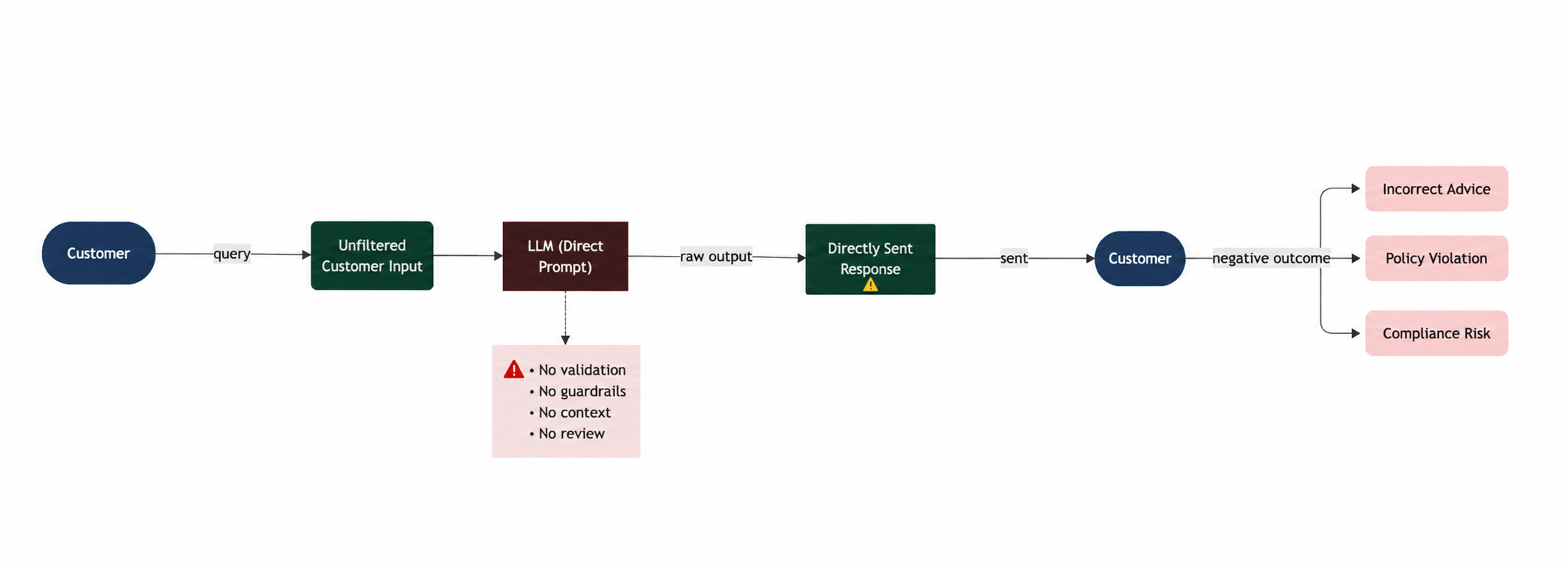
Why an LLM-Driven Chatbot Becomes Less Reliable in Production
A large language model is excellent at language. It can interpret tone, understand intent, summarize context, and generate responses that feel remarkably natural. That makes it tempting to place a model directly in the middle of a workflow and let it decide what happens next. In practice, that tends to be unpredictable. The reason is not usually that the model generates poor responses. The challenge is that businesses already operate through structured systems. There are escalation paths, approval rules, timing requirements, templates, exceptions, and operational decisions that happen every day before AI ever enters the conversation. Those rules are often specific to the business and often exist for good reason. Customer communication may need to happen in a certain sequence. A workflow may need to pause until another system confirms information. Some interactions may require escalation while others should resolve automatically. An LLM can understand language inside that workflow, but that does not automatically make it the right place to manage the workflow itself. The more business rules and edge cases you push into one large prompt, the harder it becomes to predict behavior consistently. That is usually where teams feel the difference between something that demos well and something that is actually dependable in production.
The Deterministic Hybrid Pattern
A better approach is treating the LLM as one component inside a larger system. We describe it as a deterministic workflow with AI handling interpretation at the right moments. The LLM is responsible for understanding language and translating it into structured information the application can actually work with. That may include identifying intent, extracting relevant context, categorizing the type of request, or recognizing whether a message needs escalation. The model performs well in two roles: LLM as judge and LLM as Shakespeare. In the first role, the model interprets language, identifies context, and helps convert messy human communication into structured information the system can work with. In the second role, once the workflow has already determined what should happen, the model helps compose a response that feels natural and conversational. That distinction matters because it gives the model room to do what it is genuinely good at without asking it to control business logic on its own. From there, the rest of the workflow stays deterministic. Routing decisions happen inside software. Business rules are enforced by the application. Validation happens before any downstream action. Human approval can be inserted when needed. Templates can ensure messaging stays consistent with compliance requirements or brand voice. Only after those decisions are made does the LLM come back in to help compose a natural response. In practice the architecture looks more like this:
That pattern matters because it separates interpretation from execution. The model handles ambiguity well. The software controls the rules.
Where Structure Enters the System
The reliability of these systems often comes down to how much structure exists around the model. A business often already knows what should happen. If a response comes in after a certain time period, a follow-up needs to happen. If a customer expresses frustration, the workflow may need a different escalation path. If a message falls into a specific category, it may need an approved response template. Those are workflow decisions. The LLM helps make sense of language inside that workflow, but deterministic systems still decide timing, sequence, and execution. That architecture ends up being easier to audit, easier to improve, and much more predictable once it is running across real customer interactions.2. Training & Iteration of Deterministic Systems
From Manual Workflows to Scalable Automation
You Are Not Training the Model: You Are Evolving the System
"Training" can be misleading language. In traditional AI conversations, training refers to the model itself. For us, the goal was instead to design a system that could improve safely over time. At the beginning there was no large production dataset. There were examples, business expectations, and domain expertise, but not years of conversation history to optimize against. That meant the workflow needed to be designed from day one to evolve while it was live. The rollout happened gradually. The system began with people reviewing everything. Then AI helped draft responses. Then specific categories moved into partial automation once confidence improved. As the workflow proved reliable in more situations, automation expanded further. That progression mattered because trust increased alongside visibility. Teams could see what was happening, understand why a change helped, and move forward carefully instead of forcing full automation too early.Real-World Feedback Drives Iteration
Human language creates endless edge cases. People say the same thing differently. Tone changes meaning. Context matters. Timing matters. Previous conversations matter. That creates complexity fast. The most useful improvement loop was not trying to anticipate every possible conversation before launch. It was learning from real-world usage and improving from actual interactions. Our approach was a feedback system that made this manageable. When someone adjusted a message manually, that feedback became a useful signal. Sometimes the issue was a business rule that needed refinement. Sometimes the response technically worked but sounded unnatural. Sometimes a specific category revealed a pattern that needed engineering attention. Those insights were much more actionable than broad assumptions. Instead of asking whether the model was "smart enough," we could identify where the workflow behaved well and where it needed refinement. That made iteration practical.Testing and Safe Automation at Scale
A big part of that evolution came from testing. We built scenario-based test suites using real-world conversations with sensitive information removed, creating a repeatable way to validate workflow behavior before changes reached production. That mattered in several ways:- It made prompt updates safer.
- It made model upgrades safer.
- It made workflow changes easier to measure.
3. Security, Observability & Safe Deployment
Why Reliable AI Needs Visibility
Safe Enough for Production Starts with Observability
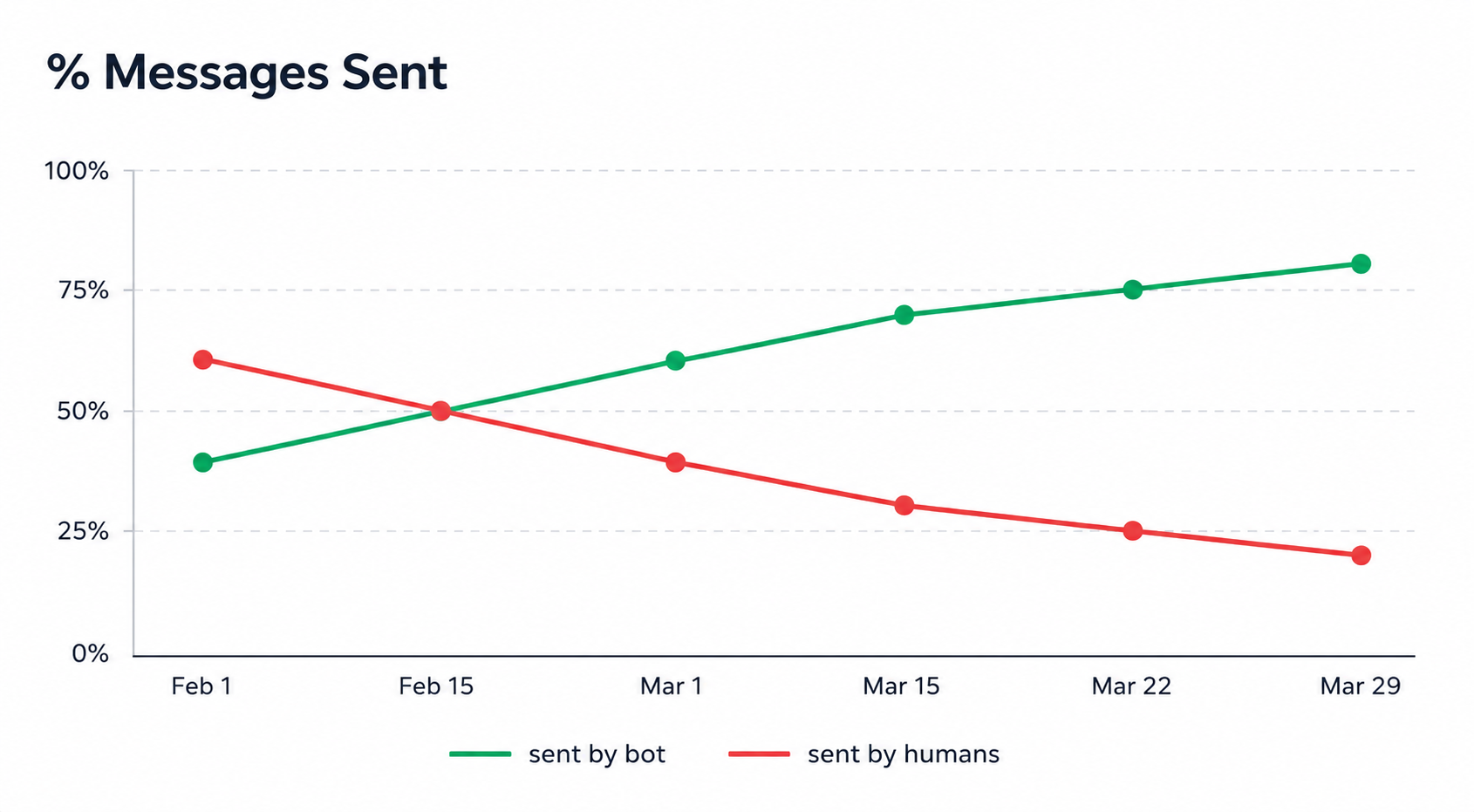
Production AI requires more than strong outputs. It also requires visibility. It is very important to understand what the workflow is doing from the beginning. That included seeing how often users accepted AI-generated messages, identifying categories that consistently worked well, surfacing areas where responses were adjusted manually, and tracking patterns over time. That kind of observability matters because teams need context. If something changes unexpectedly, they need to know why. If automation improves, they need to understand what drove the improvement. If a workflow breaks, they need a clear path to isolate the issue and correct it. Without instrumentation, teams are operating on instinct. With observability, AI becomes something teams can actively improve.Defining Boundaries for the LLM
A helpful part of the discussion centered around boundaries. LLMs can classify information. They can interpret nuance. They can draft natural responses. That is valuable. But the system still decides what actions are allowed. The model should not independently trigger sensitive workflow decisions. It should not bypass compliance requirements or decide operational rules on its own. Instead, it produces structured outputs that move through deterministic validation before the system does anything downstream. That boundary keeps the model useful while keeping business logic predictable. It also gives engineering teams more flexibility over time because different models can be evaluated for different parts of the workflow without redesigning the entire system.The Broader Opportunity for Production AI
The opportunity with AI is not simply replacing existing systems with a chatbot. It is building better systems around communication and structured decisions. Any workflow that depends on repeated human interaction, operational decision-making, or customer communication becomes much more manageable when LLMs help interpret language and deterministic systems control what happens next. That can apply to customer operations, internal workflow automation, scheduling systems, regulated communication, and many other business processes. The teams seeing the strongest long-term results are usually not asking AI to replace every decision. They are designing systems where AI helps people and software work together more effectively: using language where language is useful and keeping execution inside systems the business can trust. That tends to be the difference between an interesting AI demo and a production system teams feel comfortable building on over time. If your team is evaluating where AI fits into customer communication or workflow automation, the hardest part usually is not adding an LLM. It is designing the surrounding system so it behaves consistently in production. That means knowing where AI should interpret language, where deterministic logic should control execution, and how teams stay informed as the system evolves. At Olio Apps, these are the kinds of production AI questions we work through with clients every day. If your team is exploring how to bring AI into customer-facing or regulated workflows, we'd love to talk.Aron Racho
CTO
Aron has lived in the Pacific Northwest since the turn of the century. He joined Scott at Olio Apps in late 2015 and helped scale the team to its present size. He is a family man and also has many hobbies, which include music composition, game programming, and reading. Aron’s areas of expertise are project management, dev team management, application architecture, and full stack engineering in Java, Golang, and React.
Share This Post
Newsletter
Monthly updates, posts and podcasts.